A connected device becomes a product only when hardware, software, operations, and business work together.
Early in my career, I thought strong hardware skills were enough to build almost any IoT product. Then my first prototype turned on – and the difficult work began.
The board worked, but the firmware was not ready. Later, the firmware worked, but the connection was unstable. Then the data reached the cloud, but the team still needed manufacturing tests, secure setup, installation, remote updates, diagnostics, and customer support.
The first prototype was a connected electronic device. Turning it into a product required many different skills.
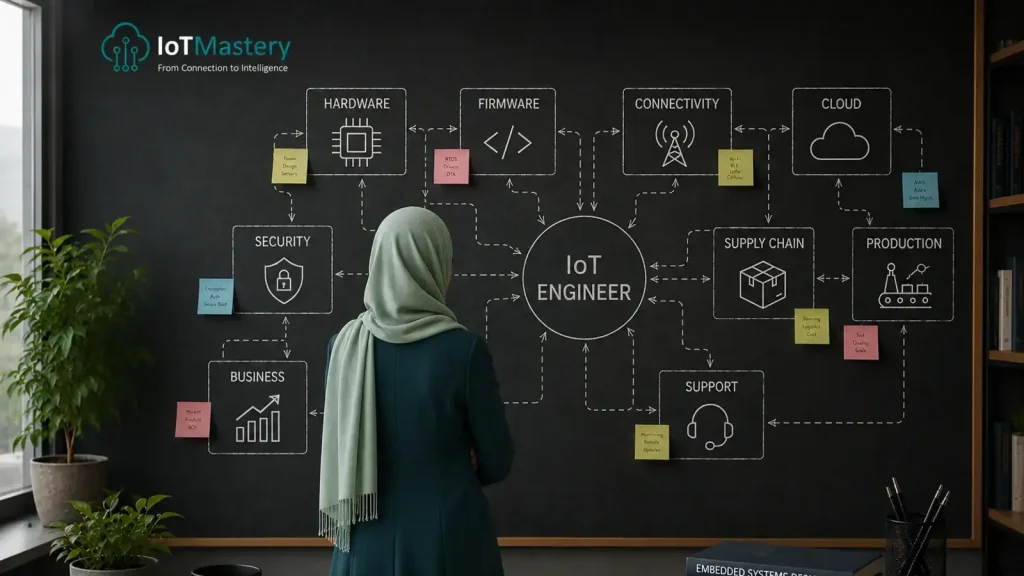
IoT is not one skill. It is a system of skills that must work together.
Learning one tool is not the same as learning IoT
ESP32, MQTT, LoRaWAN, Python, Node-RED, Arduino, and cloud platforms are useful tools. A course can teach you how to read a sensor and show its value on a dashboard. That is a good start, but it is not the full product.
A real IoT product also needs power design, embedded software, connectivity, cloud services, security, manufacturing, installation, device management, support, pricing, and supply planning. A serious weakness in one area can cancel good work in all the others.
Why the demo works but the product fails
Imagine a tracker on a desk. It gets power, finds the network, sends its location, and places a dot on a map. The demo looks successful.
Now install 10,000 trackers in vehicles. Some vehicles enter areas with no coverage. A few devices lose power. SIM cards are activated incorrectly. One firmware update stops halfway. The support team sees missing data but does not know whether the cause is the device, the network, or the cloud.
In the laboratory, an engineer can restart one device. In the field, sending a technician to thousands of vehicles may cost more than the hardware. Offline storage, diagnostics, secure provisioning, and safe remote updates are therefore part of the product, not optional extras.
Most difficult problems happen between teams
An IoT project may have excellent specialists and still fail at the boundaries. A hardware engineer chooses a component without checking its long-term supply. A firmware developer saves battery by sending less data but removes information the support team needs. A cloud design assumes that devices are always online. Sales promises faster reporting without knowing that it will increase power and data costs.
Systems thinking means seeing these connections before they become expensive. One person does not need to perform every job. But someone must understand the whole product well enough to ask the right people the right questions.
Depth plus useful breadth
For example, a firmware engineer does not need to become an antenna designer or a cloud architect. The engineer should still understand how reporting frequency affects battery life and data cost, how devices receive credentials in production, and what information support needs during a failure.
One change can affect the whole product
Suppose a customer asks for a location report every ten seconds instead of every five minutes. It sounds like a software setting. In practice, it may increase network traffic, server load, battery use, and monthly operating cost. A larger battery may then require a bigger enclosure and a different installation method.
In IoT, a local decision often creates a system-wide cost.
A practical learning path
- Map one product. Follow power, data, commands, identity, manufacturing, installation, updates, support, and revenue from beginning to end.
- Follow one failure. Take a problem such as missing data and check every possible layer, from the sensor to the cloud.
- Add field conditions. Test offline operation, diagnostics, secure setup, and recovery from a failed update.
- Work with another specialist. Ask someone in manufacturing, security, cloud, support, or sales to review your design.
- Study decisions. For each tool, learn when to use it, what it costs, what it depends on, and how it fails.
Why I built IoTMastery
Many IoT courses end when a sensor value appears on a dashboard. For a commercial product, that is where much of the work begins. IoTMastery focuses on the decisions needed to manufacture, deploy, update, support, and sell the product.
The idea to remember: You do not need to become a one-person IoT company. Build real depth in one field, then learn enough about the surrounding system to help hardware, firmware, connectivity, cloud, operations, and business work as one product.