
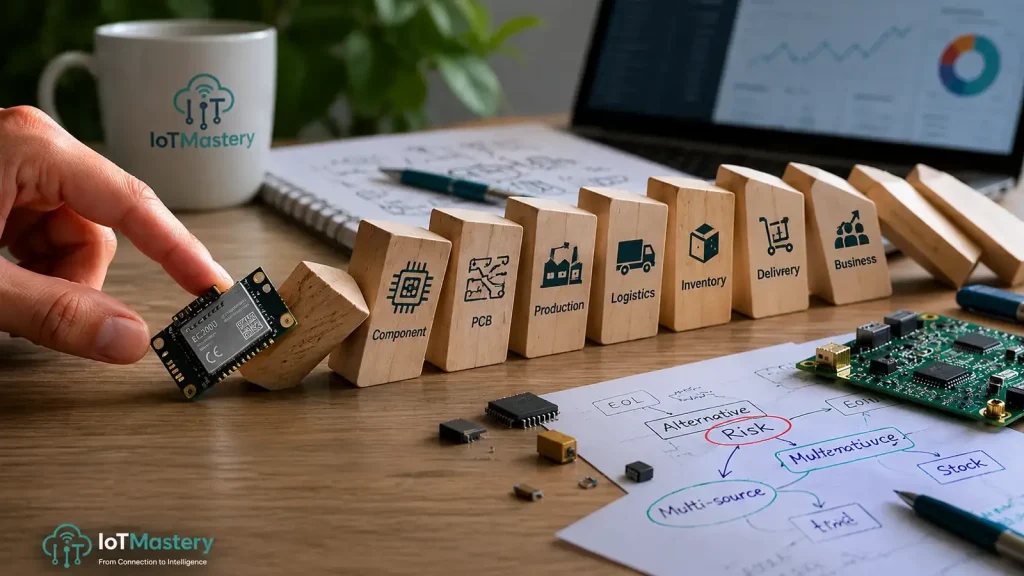
A product is not ready for the market if one unavailable part can stop every shipment.
During the COVID-19 pandemic, a global shortage of chips and electronic parts stopped production in many industries. Some IoT companies had customers and working products, but they could not build the next batch.
Before the crisis, a team might order a module and receive it within a few weeks. Then lead times grew to many months. Prices changed, shipping slowed, and larger buyers received priority. A product could be blocked by one small part that cost only a few dollars.
This was a global crisis that most people knew about. It made one lesson very clear: a design that works perfectly on a desk is not a successful product if the company cannot manufacture it again.
The hidden single point of failure
Engineers usually look for technical risks such as software bugs, weak power design, security problems, or poor connectivity. Supply risk is easier to miss because it does not appear in the circuit diagram.
Imagine a vehicle tracker that uses one specific cellular module. The whole design depends on its size, pins, electrical behavior, commands, and approvals. If that module disappears from the market, the company cannot simply buy another one. It may need a new PCB, firmware changes, antenna tests, certification work, and a new production process.
The cheapest irreplaceable part can stop the most expensive product.
A component can become unavailable for many reasons: a factory problem, a product reaching end of life, a new export rule, a shipping disruption, or sudden demand from a much larger industry. The exact cause is hard to predict. The dependency is not.
Design for replacement before the crisis
Not every component needs a perfect drop-in replacement. A standard resistor is usually easy to change. A cellular module, special sensor, secure chip, power-management IC, or unusual connector may be much harder.
List the high-risk parts in the bill of materials. For each one, ask: Is there another supplier? Have we bought samples? What changes would be needed? Would a replacement affect firmware, the PCB, the enclosure, the antenna, testing, or certification?
A similar datasheet does not guarantee an easy replacement. Two modules may support the same network but use different commands or behave differently when the signal is weak. The alternative must be tested in the real product.
Make the firmware easier to change
Replacement becomes much harder when vendor-specific commands are spread through the whole firmware. Keep those details inside one driver or hardware layer. The main application should use a clear interface such as connect, send, receive, and check signal.
This does not make two components identical. It keeps their differences in one place. When a supplier changes, the team updates a defined part of the system instead of rewriting the whole product.
A practical second-source process
- Map. Find every component that has only one approved source or a long delivery time.
- Rank. Focus first on parts that are hard to replace and can stop important sales.
- Test. Buy samples and test alternatives in the real hardware and firmware.
- Record. Keep approved suppliers, test results, supported firmware, and PCB versions up to date.
- Practise. Build a small batch with the alternative before an emergency happens.
An alternative listed in a spreadsheet is not a real second source until it has been tested.
Inventory helps, but it is not the whole answer
Keeping extra stock can protect production while the team waits for new parts or tests an alternative. But too much stock locks up cash and can become useless if the product changes.
This is especially important for cellular devices. A company may buy years of modules and later discover that a network technology is being retired in a target country. Inventory decisions must consider the product roadmap, not only the current price.
Questions to ask now
- Which parts currently have only one tested supplier?
- How long would a real replacement take, including firmware and certification?
- Have we tested the alternative or only found its part number?
- How much stock gives us time to react without creating too much obsolete inventory?
- Who reviews these risks as sales forecasts and product plans change?
The idea to remember
The technically best component is not always the best business choice. A widely available part with long-term support and a realistic replacement path may protect far more revenue.
Design for the day when normal purchasing stops working. Customers may never see that preparation, but it can decide whether they receive the product at all.